 Dydxtrade
 margin modes determine how perpetual positions share collateral
Updated -
Dydxtrade margin modes determine which collateral supports a perpetual position on dYdX Chain. Cross margin combines eligible positions within a shared collateral pool. Isolated margin assigns collateral to a specific position through a separate subaccount. A market that requires isolation also imposes protocol-level restrictions beyond that margin selection.
Shared Collateral and Separate Subaccounts
Gains and losses across cross positions affect the equity in their shared subaccount. A loss on one position can reduce the backing available to the others. Isolated allocations separate that supporting collateral at position level. The same wallet can control both arrangements, while their subaccounts hold different collateral and position records.
The interface uses subaccount 0 as the cross account for its isolated-margin transfers. It allocates collateral to another eligible subaccount that has no open positions or orders. The trader can manually adjust the collateral supporting the isolated position. Moving funds out of the cross pool leaves fewer funds there to support its remaining cross positions.
Is an Isolated Market the Same as Isolated Margin?
An isolated market requires isolated margin at the protocol level; isolated margin is also an allocation choice for otherwise eligible markets. A trader can therefore choose separate collateral for a position without making its market an isolated market.
A subaccount holding an isolated perpetual cannot also hold other perpetual positions. The protocol keeps collateral and an insurance fund specific to that isolated market. Cross markets use a shared insurance fund and permit shared collateral across eligible positions. Choosing isolated margin within a cross market does not change that market's protocol classification.
Target Leverage and Collateral Transfers
Target leverage sets the amount of collateral that the interface transfers with the next opening or increasing order. Editing that target alone leaves existing collateral in place. A reducing order transfers no additional collateral to the isolated position. Manual margin adjustments provide a separate way to change the position's allocated backing.
How Does Collateral Move Through an Isolated Limit Order?
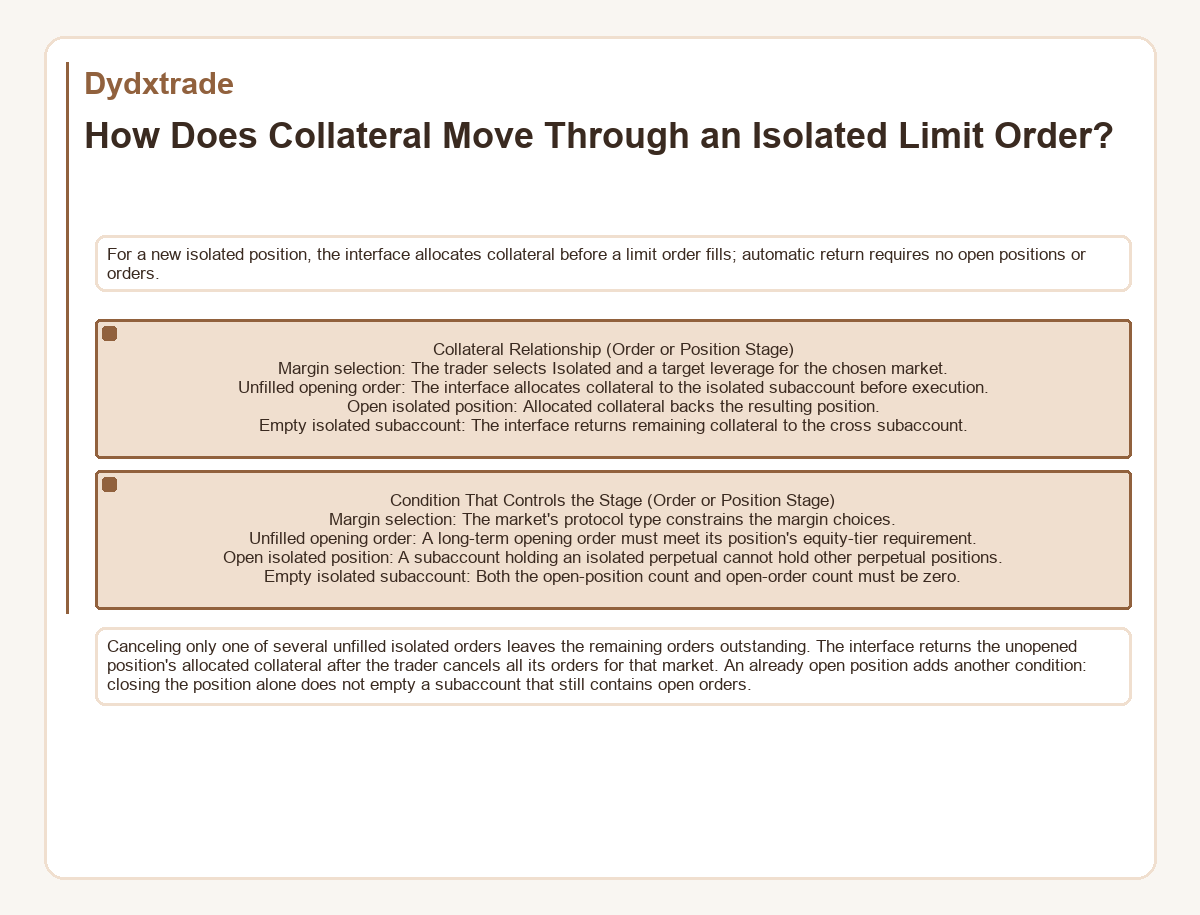
For a new isolated position, the interface allocates collateral before a limit order fills; automatic return requires no open positions or orders.
| Order or Position Stage | Collateral Relationship | Condition That Controls the Stage |
|---|---|---|
| Margin selection | The trader selects Isolated and a target leverage for the chosen market. | The market's protocol type constrains the margin choices. |
| Unfilled opening order | The interface allocates collateral to the isolated subaccount before execution. | A long-term opening order must meet its position's equity-tier requirement. |
| Open isolated position | Allocated collateral backs the resulting position. | A subaccount holding an isolated perpetual cannot hold other perpetual positions. |
| Empty isolated subaccount | The interface returns remaining collateral to the cross subaccount. | Both the open-position count and open-order count must be zero. |
Canceling only one of several unfilled isolated orders leaves the remaining orders outstanding. The interface returns the unopened position's allocated collateral after the trader cancels all its orders for that market. An already open position adds another condition: closing the position alone does not empty a subaccount that still contains open orders.
Unfilled Orders and Equity Tier Requirements
Each isolated position must independently meet the equity-tier requirement for a long-term opening order. Equity tiers constrain how many stateful orders a subaccount can keep open. A sufficiently funded cross account therefore does not establish that its isolated subaccount meets the requirement.
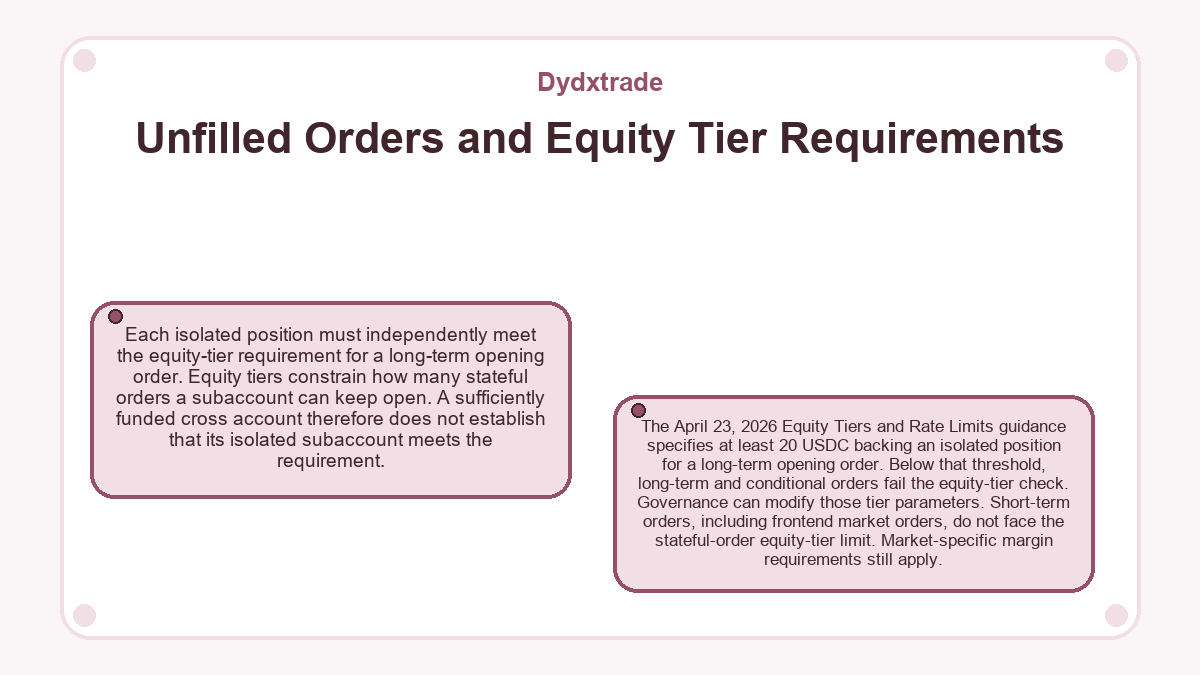
The April 23, 2026 Equity Tiers and Rate Limits guidance specifies at least 20 USDC backing an isolated position for a long-term opening order. Below that threshold, long-term and conditional orders fail the equity-tier check. Governance can modify those tier parameters.
Short-term orders, including frontend market orders, do not face the stateful-order equity-tier limit. Market-specific margin requirements still apply.
Initial Margin, Maintenance Margin, and Liquidation
Initial margin governs opening or increasing exposure, while maintenance margin determines whether existing equity sufficiently supports an open position. These requirements belong to the relevant market and supporting subaccount. Cross margin applies them against the shared pool; isolated margin applies them against the backing of the separated position.
At a market's base requirement, the reciprocal of its initial margin fraction describes the corresponding maximum leverage. Applicable requirements can rise as position size or market open interest crosses configured thresholds. The interface can therefore reject an increase even when a trader selected a target leverage that appeared usable for smaller exposure.
A position can reach its liquidation threshold after adverse price movement reduces the supporting equity. Funding payments also affect profit and loss while exposure remains open. Those payments can add to or subtract from the equity available against maintenance requirements, depending on the position and funding rate.
Which Constraints Remain Shared Across Margin Modes?
Both margin modes remain subject to dYdX Chain withdrawal controls and the frontend's location restrictions. Returning isolated collateral restores it to the cross account; external withdrawal remains a separate operation with its own protocol controls. Noble USDC withdrawals face protocol-wide rate limits that governance can change. Chain outages can also trigger transfer and withdrawal gates across subaccounts. Frontend restrictions include the United States, Canada, and the United Kingdom, regardless of a position's selected margin mode. Close-only mode allows order cancellation, position reduction or closure, and withdrawals, but disables deposits, transfers, and new positions. After seven consecutive days in that mode, the wallet transitions to blocked status, preventing frontend trading and withdrawals.
Dydxtrade questions worth asking
Why Can Adding USDC to MegaVault Leave Less Cross Margin Available?
MegaVault draws funds from the cross-margin balance, so adding funds raises cross-margin usage when cross positions remain open. Its balance does not count toward tradable equity. These funds enter automated vault strategies and remain distinct from the collateral that the trading account can use to support orders.
Can Unrealized Profit or Loss Change an Isolated subaccount's Order Allowance?
Unrealized profit and loss affect the equity that determines an isolated subaccount's equity tier. A position's changing value can therefore increase or decrease its permitted number of open stateful orders. That allowance reflects the equity recorded in the relevant subaccount and the applicable tier configuration.
Do Isolated Subaccounts Receive Separate Block Rate Limits?
Isolated subaccounts under the same dYdX Chain account share that account's block rate limits. Allocating collateral separately therefore does not multiply the permitted order-submission rate. These limits govern placement attempts over block windows, while equity tiers govern open stateful orders. Both successful and failed attempts can count.
Which Market Risks Remain Relevant After Choosing Isolated Margin?
Oracle sources and underlying spot liquidity remain relevant after choosing isolated margin. Fewer oracle sources and thinner liquidity generally increase an isolated market's risk. Separate collateral and a dedicated insurance fund do not remove those market-specific characteristics.
Does Filling an Isolated Order Free Capacity Under the Equity Tier?
Filled stateful orders no longer count toward the open-order allowance that an isolated subaccount's equity tier controls. A filled order can create or enlarge a position, so freeing an order slot does not release the collateral supporting that position.