 Dydxtrade
 funding rates change realized P&L while perpetual positions remain open
Updated -
Dydxtrade funding rates determine recurring payments between long and short perpetual positions on dYdX Chain. Positive rates make longs pay shorts; negative rates reverse that direction. Under the default hourly schedule, these payments change realized profit and loss (P&L) while a position remains open. Funding encourages perpetual prices to stay near the oracle price without fixing their trading price.
Topics on this page
A position can gain from a favorable price move while paying funding that reduces its overall return. Interpreting that cost requires the rate period, payment direction, and position exposure, followed by the actual debits or credits in account history.
Key takeaway: Funding debits reduce account equity before a position closes, so payment history helps explain changes beyond price movements.
Funding Direction and Position Returns
The applicable funding rate determines whether an open long or short position pays a holding cost or receives a payment during that funding interval. The same market can change funding direction between intervals. A position that previously received funding can later owe it, even without changing its trade direction.
| Funding Rate | Long Position | Short Position | Misreading That Distorts Returns |
|---|---|---|---|
| Positive | Pays funding | Receives funding | Treating a short position's funding receipts as its total profit |
| Negative | Receives funding | Pays funding | Treating a long position's funding receipts as its total profit |
| Zero | No funding payment for that interval | No funding payment for that interval | Assuming later intervals also have zero funding |
Funding receipts contribute to returns alongside price gains or losses. A receiving position can still lose value overall if adverse price movement outweighs those receipts. Conversely, a paying position can remain profitable when its price gains exceed funding and execution costs.
Notional Exposure and Margin Sensitivity
The default dYdX Chain funding mechanism bases payments on the position's oracle-valued notional. Notional measures the market value of the exposure. The collateral supporting that exposure is a different quantity.
For one default hourly funding tick, the economic relationship before protocol rounding is
Account funding change = -S * P * r
.
The signed position size
S
is the base-asset quantity open at the funding tick: positive for a long and negative for a short. The oracle price
P
supplies the USD value per base-asset unit at that tick. The decimal rate
r
covers that hourly interval. The chain accounts for the settlement in USDC. A positive account change denotes a receipt; a negative change denotes a debit.
Using collateral as the multiplication base understates exposure whenever the position's notional exceeds its backing. Holding the same position with less supporting equity increases the funding payment relative to that equity. Changing collateral alone does not change the market's funding rate.
Cross margin and isolated margin determine which collateral supports a position. Those arrangements affect where a funding debit reduces backing. They do not replace the position's notional with its margin balance when determining the payment.
Hourly Payments and Displayed Rate Periods
The funding display can express a selected market's rate over one hour, eight hours, or an annualized period without changing the default hourly payment schedule. The selected period belongs with the percentage whenever rates enter a cost estimate. An eight-hour quotation cannot serve directly as the hourly multiplier in a payment calculation.
Annualization expresses a rate on a yearly scale. It does not establish the return that a position will earn during a year. For a holding period covering several funding ticks, total funding follows the payments across those intervals. Multiplying one quoted rate across the whole period assumes that both the rate and the relevant position exposure remain unchanged.
Perpetual Prices and the Funding Premium
Funding creates an incentive for perpetual prices to approach their underlying reference because these contracts have no expiry date that forces a final settlement or delivery. A premium above the reference creates pressure toward payments from longs to shorts. A discount creates pressure in the opposite direction. The final funding rate also includes the applicable interest component and protocol limits.
Funding incentives do not force the order book to trade at the oracle price. The premium and the executed market price describe different measurements, so one candle or recent fill cannot reproduce the rate calculation. A rate also describes funding conditions, rather than predicting the direction of the underlying asset's next price move.
Order Book Depth in the Premium Calculation
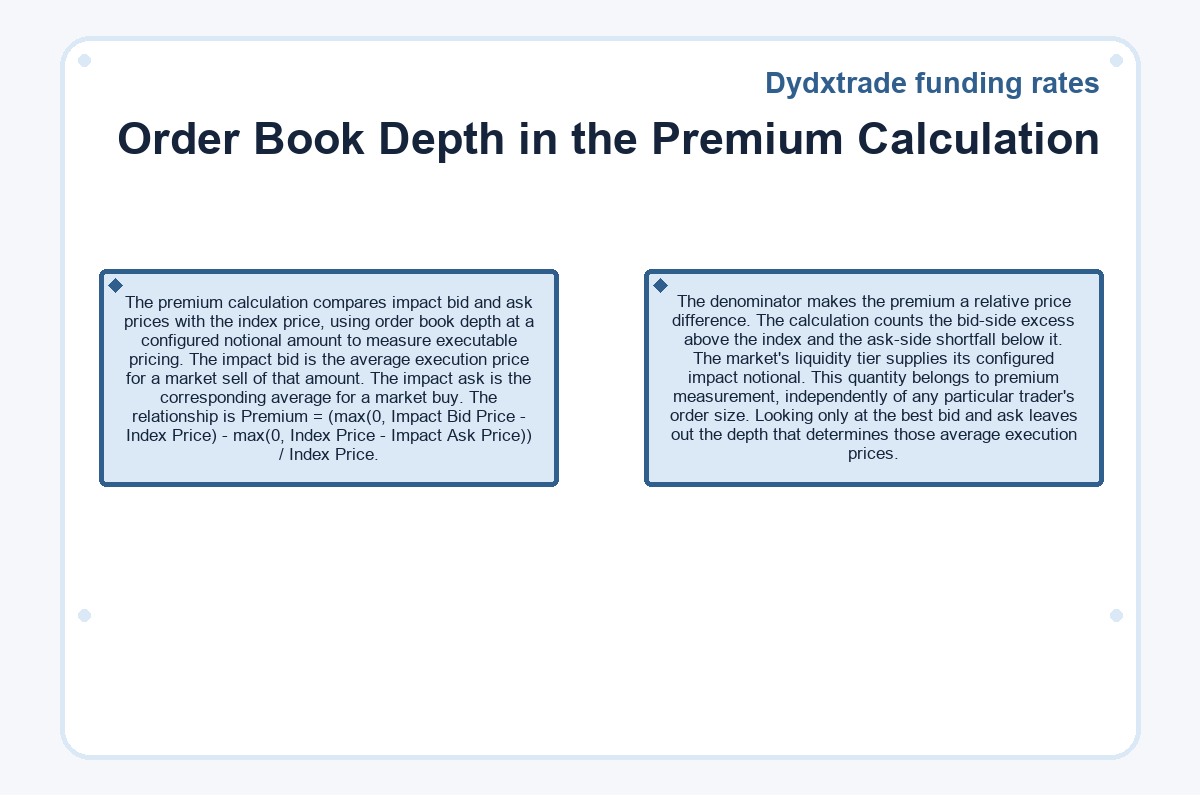
The premium calculation compares impact bid and ask prices with the index price, using order book depth at a configured notional amount to measure executable pricing. The impact bid is the average execution price for a market sell of that amount. The impact ask is the corresponding average for a market buy.
The relationship is
Premium = (max(0, Impact Bid Price - Index Price) - max(0, Index Price - Impact Ask Price)) / Index Price
. The denominator makes the premium a relative price difference. The calculation counts the bid-side excess above the index and the ask-side shortfall below it.
The market's liquidity tier supplies its configured impact notional. This quantity belongs to premium measurement, independently of any particular trader's order size. Looking only at the best bid and ask leaves out the depth that determines those average execution prices.
Premium Sampling and the Funding Tick
Block proposers contribute premium votes from their local order book views, and the protocol summarizes those votes into samples before calculating a market's funding update. The default sampling interval is one minute. Within a sampling interval, the protocol takes the median of the collected votes, subject to its minimum-vote rules.
The default v4 funding-tick interval is one hour. Tick processing combines the preceding samples, adds the market's default funding component, and applies the funding-rate clamp. It scales the resulting eight-hour rate to the tick duration. Governance can change sampling and funding intervals, so the hourly schedule describes the default configuration.
Market Interest Components
The interest component supplies a market-specific contribution to funding, which means a zero premium does not necessarily produce a zero payment for an open position. Under the default hourly schedule, the unclamped relationship is
Hourly rate = averaged premium / 8 + hourly interest component
. The division converts the premium's eight-hour realization basis into an hourly rate.
Market configuration determines the applicable interest component. Cross and isolated markets can have different defaults. Choosing isolated margin for a position in a cross market does not itself reclassify that market. The final signed rate determines payment direction after the components and limits interact.
Rate Caps and Margin Parameters
In the v4 mechanism, the eight-hour absolute funding-rate cap equals the configured clamp factor multiplied by the difference between the liquidity tier's base initial and maintenance margin fractions. Both margin fractions use position notional as their basis. Governance can adjust the clamp factor and market parameters. The cap limits the rate for its applicable period; successive payments can still accumulate, and the position remains exposed to price losses.
Payment History and P&L Reconciliation
Funding payment history records the account's debits and credits, while a market's historical rate series records percentages that require position exposure to explain a cash amount. The dYdX trading frontend places funding payment history under Portfolio and History. For wallets subject to geolocation enforcement, seven consecutive days in close-only mode lead to Blocked status, which prevents viewing trading history through the frontend. The positions panel also contains funding and equity information. A current rate display describes a different observation from a payment already recorded against the account.
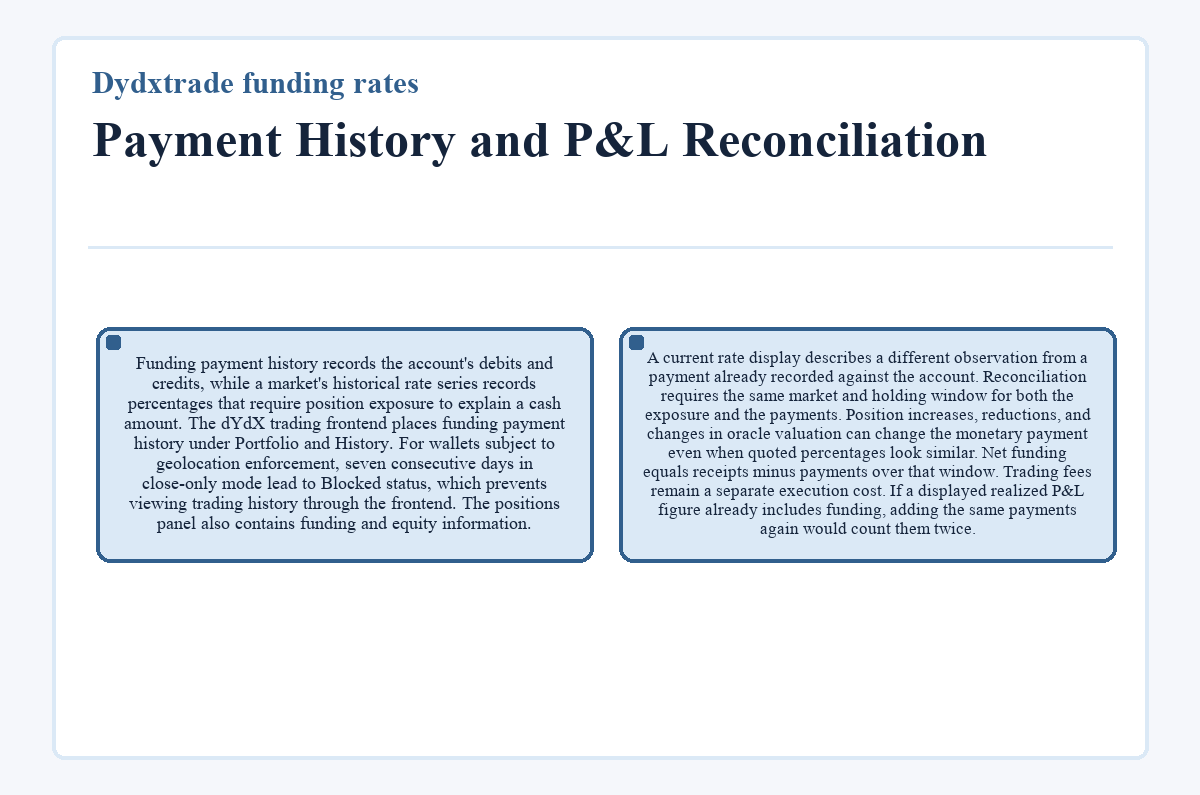
Reconciliation requires the same market and holding window for both the exposure and the payments. Position increases, reductions, and changes in oracle valuation can change the monetary payment even when quoted percentages look similar. Net funding equals receipts minus payments over that window. Trading fees remain a separate execution cost. If a displayed realized P&L figure already includes funding, adding the same payments again would count them twice.
Funding Changes and the Holding Decision
An entry-time funding quote does not lock later holding costs, because subsequent intervals can produce different rates and the position's oracle-valued exposure can change. Funding outflows reduce the benefit of a favorable price move. Receipts offset part of an adverse move without removing that exposure. A submitted exit order leaves funding exposure attached to any portion of the position that remains open.
Quick answers about Dydxtrade funding rates
-
Does a Post-Only Order Change My Funding Rate?
- Post-Only controls the execution fee classification of a filled order, while funding follows the open position and its market's applicable funding rate. The setting makes an order rest on the book or cancel if it would cross existing liquidity. Maker status does not create a separate funding schedule.
-
Can an Unfilled Entry Order Receive Funding?
- An unfilled entry order that has created no position does not receive funding. Funding attaches to open perpetual exposure, so an existing position in the same market can still pay or receive it while another order waits. Canceling the waiting order leaves that existing exposure unchanged.
-
Why Can a Funding Debit Affect My Open-Order Allowance?
- A funding debit can reduce the subaccount's net collateral enough to move it into a lower equity tier for stateful open orders. Those tiers govern long-term and conditional order capacity. Short-term orders have different limits, and subaccounts under the same account also share the applicable block rate limits.
-
Is MegaVault's APR the Funding Rate on My Perpetual Position?
- MegaVault's APR measures annualized vault performance rather than the funding rate on an individual perpetual position. Its displayed calculation uses past 90-day performance, which includes trading P&L, funding, protocol fee revenue, and other incentives. A positive vault APR can therefore coexist with losses on the vault's trading positions.
-
Can a Funding Credit Prevent Liquidation?
- A funding credit increases account equity, but liquidation still depends on whether the collateral supporting the position satisfies its maintenance requirement after price changes and other account effects, so receiving funding alone cannot establish that the position will remain adequately collateralized.
-
Which Account Details Does the API Need for Funding Payment History?
- The Indexer API identifies personal funding payments using the dYdX Chain address and subaccount number. Its funding-payment query can filter by market and timestamp. A separate parent-subaccount query aggregates child subaccounts, which helps distinguish payments across positions from a historical market-rate series that contains no personal settlement amount.